Gita Bangera, Senior Vice President, NWCCU
With our continuing series of articles demystifying the 2020 Standards for Accreditation, NWCCU aims to support and guide its member institutions on their journey of continuous improvement to promote student success and close achievement gaps. In this latest article, we discuss Standard 2.I.1, which is a foundational standard on which the other Standards build (excuse the pun!). This is a crucial Standard that expands upon the stipulations of Eligibility Requirement #15.
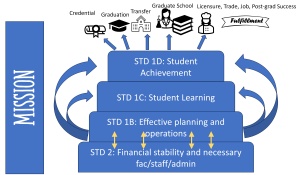
As discussed in a previous Beacon article, the physical environment and technology infrastructure of an institution form the base for effective planning and operations (Standard 1.B) that lead to student learning (Standard 1.C) and student achievement (Standard 1.D). See Figure 1. Specifically, Standard 2.I.1 also provides the basis for the requirement of “effective learning environments” in Standard 2.G.1.
Standard Two – Governance, Resources, and Capacity
Physical and Technology Infrastructure
2.I.1 Consistent with its mission, the institution creates and maintains physical facilities and technology infrastructure that are accessible, safe, secure, and sufficient in quantity and quality to ensure healthful learning and working environments that support and sustain the institution’s mission, academic programs, and services.
Mission-Driven Design
The intent of Standard 2.I.1 is for the institution to establish and maintain physical facilities and technology infrastructure that align with, support, and sustain the institution’s mission. The alignment of physical facilities and technology infrastructure with the institution’s mission is crucial and ensures that the infrastructure not only supports but also enhances the institution’s goals and objectives. A research-focused university might prioritize state-of-the-art laboratories and research centers, while a liberal arts college might place greater emphasis on creating collaborative learning spaces. For a tribal college, emphasizing cultural spaces that honor and integrate indigenous cultures, values, and traditions could be a priority. For some institutions, incorporating sustainable practices in the design and maintenance of facilities and technology infrastructure would align with broader institutional goals of environmental stewardship.
Accessibility: Bridging the Gap
Aligned with the federal Americans with Disabilities Act (ADA), accessibility is a cornerstone of any educational institution’s infrastructure. It ensures that all students, faculty, and staff, regardless of physical abilities, can fully participate in the academic community. This includes:
- Physical Accessibility: Buildings and facilities must comply with ADA standards, including ramps, elevators, and accessible restrooms. Classrooms and common areas should be designed to accommodate individuals with mobility challenges.
- Technological Accessibility: Per federal regulation Section 508, digital platforms and resources must be accessible to all users, including those with visual, auditory, or cognitive impairments. This involves the use of screen readers, captioned videos, and accessible web design.
Institutions must regularly assess and update their facilities and technology to ensure they meet these standards, fostering an inclusive environment where everyone can thrive.
Safety and Security: Protecting the Community
The safety and security of physical facilities and technology infrastructure are critical to maintaining a healthful learning and working environment. This encompasses:
- Physical Safety: Regular maintenance and inspections of buildings and facilities to prevent accidents and ensure compliance with safety regulations. This includes fire safety measures, secure entry points, and well-lit campuses.
- Cybersecurity: Protecting the institution’s digital infrastructure from cyberattacks is essential. This involves implementing robust cybersecurity measures, such as firewalls, encryption, and regular security audits to safeguard sensitive data and maintain the integrity of digital systems.
Institutions must develop comprehensive safety and security plans, conduct regular drills, and provide training to staff and students to ensure preparedness for any potential threats.
Sufficiency in Quantity and Quality: Meeting the Needs
To support and sustain the institution’s mission, academic programs, and services, facilities and technology infrastructure must be sufficient in both quantity and quality. This includes:
- Adequate Facilities: Ensuring there are enough classrooms, laboratories, libraries, and recreational spaces to accommodate the student population. Facilities should be equipped with modern amenities and resources that enhance the learning experience.
- Advanced Technology: Investing in up-to-date technology infrastructure, including high-speed internet, state-of-the-art computer labs, and advanced research equipment as may be relevant to the institution’s mission. This also involves providing ongoing technical support and training for faculty and students.
Institutions should regularly evaluate their facilities and technology to identify areas for improvement and ensure they are meeting the evolving needs of their academic community.
Evaluation
Standard 2.I.1 is evaluated as part of the Policies, Regulations, and Financial Review (PRFR) process. However, because the PRFR is a desk audit, assessment of the physical infrastructure is also included in the comprehensive, onsite Year 7 Evaluation of Institutional Effectiveness (EIE) peer evaluation.
For their PRFR self-evaluation report, institutions must provide evidence for compliance with Standard 2.I.1 as outlined in the PRFR Panel Template by providing a Facilities Master Plan.
Facilities Master Plan
An institution’s facilities master plan is its blueprint for ensuring that its physical and technology infrastructure components are sufficient and well maintained. This plan should cover the various aspects mentioned above and include:
- Equipment Replacement Policies/Procedures: With the rapid pace at which technology changes, it is critical that institutions have policies and procedures in place to maintain and update equipment needed for day-to-day operations. For institutions that offer credentials in high-tech fields, it is essential to plan for the maintenance of quality and currency of the required technical infrastructure as well as training for faculty and staff using the technology. In addition to policies and procedures, institutions could provide budgetary evidence of resources allocated towards this goal.
- Sufficiency of Physical Facilities and Handling of Hazardous Waste: Institutions should share plans and procedures in place for evaluating the sufficiency of physical facilities, especially with the development of new programs and/or enrollment growth. Institutions should provide evidence of policies and/or procedures for the use, storage, and disposal of hazardous waste.
- Policies and Procedures for Ensuring Accessible, Safe, and Secure Facilities: In addition to the requirements of the ADA, institutions are expected to ensure safe and secure facilities for all students. Given the rising incidents of gun violence on college campuses, it is crucial for institutions to establish comprehensive procedures and plans to address situations involving active shooters. The recent surge in political unrest also necessitates that campuses develop contingency plans to address the occupation of premises by protestors. In case of interruption of educational programming due to various natural or human-caused disasters, institutions are expected to have established plans for continuity of operations. Standard 2.I.1 does not specifically mention continuity of operations because that expectation is included in ER15. Institutions with residential facilities should provide information regarding the policies, procedures, and plans in place to ensure that those facilities are accessible, safe, and secure.
- Technology Master Plan and Planning Processes: A technology master plan is crucial for institutions to ensure the security and efficiency of their operations. With the increasing threat of cyberattacks, a comprehensive plan helps safeguard sensitive student and employee data. It outlines strategies for robust cybersecurity measures, including regular updates and monitoring systems to detect and respond to threats promptly. By prioritizing data security and technological advancement, institutions can protect their community and maintain trust, fostering a safe and innovative learning environment.
Continuous Improvement: A Commitment to Excellence
NWCCU expects its institutions to adhere to the principle of continuous improvement in upholding high standards for physical facilities and technology infrastructure. Conducting regular assessments and audits of facilities and technology, staying abreast of technological changes, and maintaining an updated strategic facilities master plan are three ways that institutions can ensure their infrastructure remains effective, relevant, and aligned with their mission and goals. By committing to continuous improvement, institutions can ensure that their facilities and technology infrastructure remain at the forefront of educational excellence.
The creation and maintenance of accessible, safe, secure, and sufficient physical facilities and technology infrastructure are vital to the success of higher education institutions. These elements are foundational to providing a healthful learning and working environment that supports and sustains the institution’s mission, academic programs, and services and where students, faculty, and staff can thrive and achieve their full potential.
Postscript: In alignment with NWCCU’s multipronged approach to supporting institutions, we will invite member institutions that are excelling in meeting this Standard to share their leading practices in future issues of the Beacon.