Michele Howser, Professor – Human Behavior, College of Southern Nevada
Judith Stewart, Professor – Biological Sciences, College of Southern Nevada
Higher education has a valuable story to tell, yet parts of that story often go untold. As described in Assessment That Matters: Trending Toward Practices That Document Authentic Student Learning, assessment of student learning is one way that institutions communicate value and tell their story. Why, then, do many colleges struggle to fully assess student learning, or to document how their use of assessment data improves student learning (Ewell, 2023).
Barriers to assessment come in many forms. Some arise from deficiencies – in resources, faculty support, sustainable processes, and culture. Others lie in tradition; faculty may already assess student learning on their own, effectively using the results to revise their courses, and see little value in further institutional assessments. Furthermore, faculty may perceive institutional assessment as a mandate disconnected from their main priority – their students.
As members of the College of Southern Nevada’s (CSN) Assessment Committee, where Dr. Howser serves as the chair, we experienced all the challenges mentioned above. CSN is a large, public four-year institution offering primarily associates degrees and certificates, with approximately 50,000 students and over 500 full-time faculty. Over the past decade faculty consistently assessed student learning in their own way, in their own courses. However, attempts to assess institutional learning outcomes college-wide failed to yield usable data.
In October 2022, CSN received a Recommendation from the Northwest Commission on Colleges and Universities (NWCCU) to identify a meaningful way to systematically assess institutional student learning outcomes and use the results to continuously improve student learning. The college recognized this issue a few months earlier, identifying a need for “faculty-led reform…to promote a pervasive culture of assessment at CSN, create a simple and unified assessment data collection and reporting process…and establish transparency in use of assessment findings” (CSN, 2022, p. 19).
The assessment committee was asked to respond to the Recommendation and create a faculty driven process to improve student learning. A few months later, in March 2023, we joined Cohort 5 as fellows in the NWCCU Mission Fulfillment Fellowship. Our project choice was clear – develop a new assessment process for the college.
First Steps
The new process needed to satisfy four criteria:
- Simple and easy to use
- Sustainable
- Produce data that faculty trust
- Support a continuous improvement cycle
In addition, increasing faculty engagement and improving transparency were priorities. We hoped the process would further embed a culture of assessment at CSN, one that promoted greater awareness of the value of assessment and encouraged collaboration between different departments and offices.
The first step was identifying new ILOs. CSN’s existing ILOs were used to assess general education courses. The committee chose to expand the ILOs, broadening their applicability to student learning in every CSN course and program rather than focusing only on general education. Referencing the AAC&U VALUE Rubrics, the committee identified five new ILOs and wrote accompanying measures. After faculty senate approval, grading rubrics were created to accompany each ILO.
To improve transparency, the first assessment workshop was held early in the process during Fall 2023 Convocation week, introducing faculty to the new ILOs, providing a general map of where we were going, and requesting their input.
Selecting Assessment Instruments
Faculty engagement was central to our project; we wanted a process built on faculty participation and choice. Whatcom Community College (WCC) received the 2021 Excellence in Assessment designation from the National Institute of Learning Outcomes Assessment in 2021 and commendations for their high level of faculty involvement. We selected Whatcom Community College (WCC) for one of our fellowship site visits and adapted their methodology to our new process. Instead of creating assessment articles in committee and administering them to graduating students as had been done previously, faculty would select at least one ILO annually to assess, and select an assignment already used in their courses as the assessment instrument.
When faculty use their current assignments as assessment instruments, the results provide authentic measures of student learning (Jankowski et al., 2018). In an assessment cycle of “assess, intervene, reassess,” intervening demands the greatest amount of faculty time and effort (Fulcher and Prendergast, 2019). Faculty disconnected from assessment planning may be unwilling to invest the time required to use institutional assessment data to improve student learning. Embedding assessment in existing course assignments also makes the process more appealing to faculty – simpler, relevant, and accessible – encouraging greater faculty participation (Davis, 2023).
Data Collection
The data collection process needed to be simple and automated due to CSN’s large size. Most faculty used Canvas to facilitate course delivery; we searched for a way to allow faculty to score their assessment articles in Canvas and submit their data seamlessly. A new program from Watermark – Planning and Self-Study – met our requirements.
CSN’s Office of Institutional Assessment and Accreditation (OAA) places the ILO rubric into a faculty member’s course and into their selected assignment. Faculty then use the rubric to score the assignment for assessment purposes at the same time they score the assignment for their course grading. At the end of the semester, the data is pulled from Canvas by the OAA.
First Pilot
Faculty volunteers were recruited for an initial pilot, which ran during the Spring 2024 semester. Results will be shared with participants and the committee during the Fall 2024 semester. The pilot generated usable data for faculty and department analysis. It also highlighted problems and deficiencies, including the need for more faculty training and data gaps that can occur with differential selection of ILOs. Feedback from participants will be used to continually revise and improve the ILOs and the process.
A New Assessment Cycle
The new assessment cycle was developed in collaboration with faculty, the faculty senate, and the OAA (Fig. 1). While reflecting a traditional assessment cycle of assess, intervene, reassess the steps in each stage were customized to CSN’s needs and community.
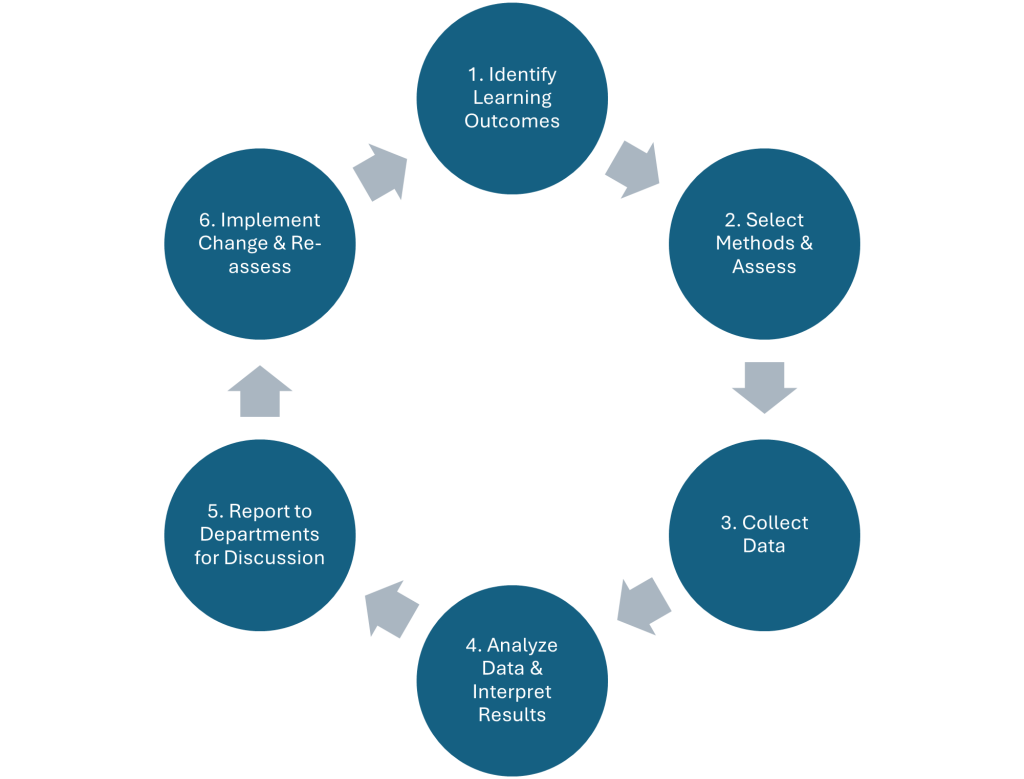
Stages 1-3 were completed during the fellowship over a period of 18 months. Stages 4-6 are ongoing. All stages will be evaluated and revised as needed while the college continues to refine the new process.
Future Steps
Plans for a second pilot in Spring 2025 are underway, supported by faculty training during Fall 2024. The Academic Affairs division and the Office of Institutional Assessment and Accreditation held CSN’s first annual Assessment Day during this semester’s convocation week. The first assessment pilot identified a need to map course Student Learning Outcomes (SLOs) to Institutional Learning Outcomes (ILOs). Many faculty hesitated to volunteer for the first pilot, concerned about the time required to identify an ILO applicable to their existing course assignments. Assessment Day activities included mapping course SLOs to ILOs, with additional mapping trainings offered over the coming months.
Future plans include creating timetables for each stage of the assessment cycle, making data easily available, formalizing a data analysis and reporting process, facilitating faculty and department discussions around assessment data, providing opportunities for faculty to tell their stories with assessment data, documenting the use of data to improve student learning, and involving students in assessment.
CSN’s new process centers assessment in a faculty-driven and faculty-reflective process, incorporating each of Booth’s (2024) three levels of assessment:
- Assessment OF learning – collecting data and measuring student learning
- Assessment FOR learning – using data to inform change
- Assessment AS learning – continuous institutional improvement
Relying on faculty engagement to advance assessment efforts and student learning at CSN supports both improvement and compliance, building on Kinzie’s recommendation to “focus on improvement, and compliance will take care of itself” (2023).
References
Booth, M. (2023, June). Institutional change and accreditation leadership: Tying the threads together for mission fulfillment. Presentation at NWCCU Mission Fulfillment June Seminar, University of Puget Sound, Tacoma, WA.
College of Southern Nevada. (2022, Fall). Evaluation of Institutional Effectiveness Report. Las Vegas, NV.
Davis, S. (2023, June). What is it that we really want to achieve. Presentation at NWCCU Mission Fulfillment June Seminar, University of Puget Sound, Tacoma, WA.
Ewell, P.T. (2023, June). Quality assessment: History, value & current context. Presentation at NWCCU Mission Fulfillment Fellowship June Seminar, University of Puget Sound, Tacoma, WA.
Fulcher, K.H. and Prendergast, C.O. (2019). Lots of assessment, little improvement: How to fix the broken system. In Hundley, S.P. & Kahn, S. (Eds), Trends in assessment: Ideas, opportunities, and issues for higher education (pp. 157-174). Stylus.
Jankowski, N. A., Timmer, J. D., Kinzie, J., & Kuh, G. D. (2018). Assessment that matters: Trending toward practices that document authentic student learning. National Institute for Learning Outcomes Assessment.
Kinzie, J. (2023, June). Introduction to assessing student learning. Presentation at NWCCU Mission Fulfillment June Seminar, University of Puget Sound, Tacoma, WA.