Sara Wilson, Executive Director, Student Success Initiatives, Western Washington University
The Western Success Scholars (WSS) program was first piloted in 2019 with grant funding from the East Seattle Foundation. The initial intent of the program was to expand Western Washington University’s capacity to serve former foster youth and/or unaccompanied homeless youth through a coordinated care management model.
A number of converging factors made this project particularly relevant for Western Washington University at the time of the initial grant application. A new University strategic plan had been identified with goals that included increasing access to higher education and graduation rates for all students in our region and state, as well as our impact in and service to the state of Washington. The Washington Student Achievement Council had made serving youth from foster care a priority, and the College Success Foundation was expanding the range of youth eligible for the Passport to College program with the addition of unaccompanied homeless youth. Western saw this as an opportunity to be a key partner in this important work in the state, to significantly expand the number of students we could serve, and to broaden the range of services we could provide to ensure students’ academic and personal success at Western.
The WSS program is committed to improving the educational outcomes for students who have experienced foster care or homelessness by providing wraparound services to meet their needs through transition, graduation, and post-graduate planning. As one former student in the program shared, “I think coming to Western has been the first time I’ve really felt such system support and it’s been fantastic to find that there are people here who are willing to offer me a safety net while I sew my parachute in free-fall.”
Prior to grant funding, there was a staff member with a .25 FTE appointment to serve approximately 20 eligible students per year. This staffing was not sufficient to meet the unique and often complex needs of this group of students or the growing number of students arriving at Western. With grant funding, a full-time program manager was hired to implement the program. With this dedicated staffing, we saw a significant increase in the ability to interact with students, to offer a broader range of programing, and better coordination with a number of key campus resources, including Financial Aid, Career Services, and the Counseling and Wellness Center. In addition to funding already received from the Washington Student Achievement Council’s Passport to Career program, permanent state funding was awarded in 2023 to ensure continuity for the program and a second full-time staff member was hired to meet the growing demand for support.
The full-time staff are certified through the Fostering Success Coaching Institute and utilize a case management approach in addressing students’ academic, personal, and social support needs. Several students have also been hired to serve as Peer Navigators/Mentors, to manage a small garden plot on campus where students grow their own food, and to serve as front desk staff in the Basic Needs Hub, where the Western Success Scholars office is co-located with Western’s Office of Off-Campus Living and the Basic Needs Resource Navigator.
The program provides a combination of services and activities that includes (1) monthly dinners and social events to build community and sense of belonging and (2) educational workshops to increase understanding of campus resources and building life skills. Workshop topics have included financial aid completion, financial literacy, career exploration, and academic advising and course planning to name a few. The WSS team also partners with other campus colleagues to host a full array of events for Hunger and Homelessness Awareness Week in November and Foster Care Awareness Month in May of each year.
A Career Development Internship initiative supports a handful of students each year to enroll in a career readiness course followed by paid internships. Support funds are used to support basic or unmet needs. Examples of this include grocery store packages, assistance with rent deposits, car repairs and/or medical bills, laptop purchases, winter clothing, and graduation regalia. WSS has also partnered with a local driving school to provide students with access to lessons and an eventual driver’s license.
“Each day presents new and unique experiences for the students served by this program – experiences that constantly test their resilience. While the work is challenging, it is so heartening to see our students build community, to lean into each other during difficult times, and to celebrate their individual and collective successes”, said Jon Stubblefield, WSS program manager.
On average, WSS currently supports 100-125 students per year and that number continues to grow each year.
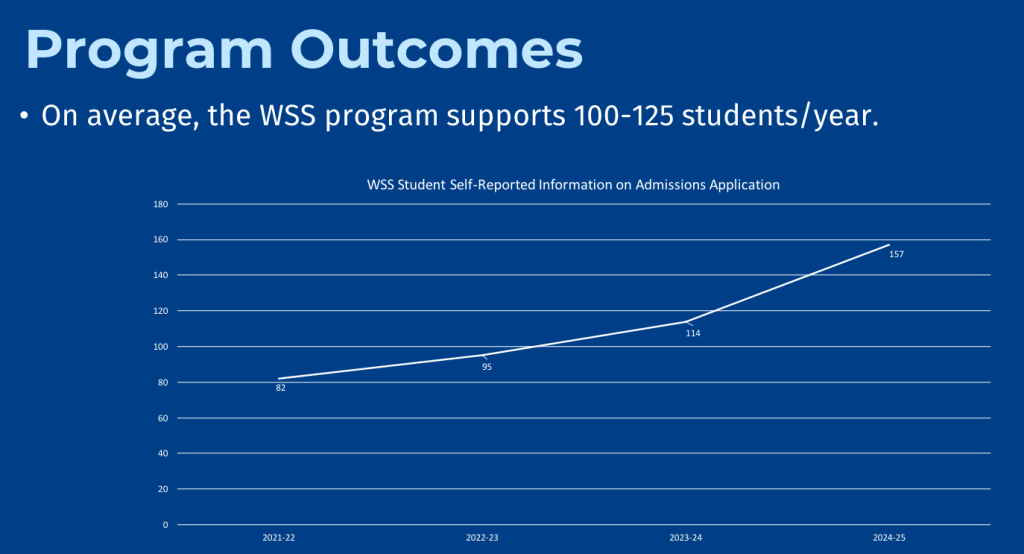
The retention range of students served by the program ranges in the upper 80th to low 90th percentile. In the past two years, a total of 40 WSS students graduated from Western. In addition, 9 out of 10 students in the program are in good academic standing, and the cumulative GPA on average is 3.0 or better.
“This program has exceeded the ambitious goals we set when the program began in 2019 with grant funding. We are thrilled that NWCCU chose to shine a light on this work in the hopes that others can replicate this transformational program on their own campuses,” said Melynda Huskey, vice president for student affairs.
For more information about this program, visit our website (https://wss.wwu.edu) or contact Jon Stubblefield, WSS program manager by email (stubblj@wwu.edu) or phone (360-650-3705).